



Reiki, Energy and Well-Being: You Don’t Have to Believe to Experience It

Updated: Sep 11
Some people come to Reiki already certain that energy is real. Others are curious. Some are sceptical. I am comfortable with all three. You do not need to arrive with a belief system. You can simply receive the session and notice what, if anything, you experience.
I believe in energy. I also believe that consciousness continues after physical death. Those beliefs are part of my spiritual understanding of life and experiences. I do not present them as scientific facts, and I do not expect everyone who comes to me to share them.
For me, Reiki is one way of working with that deeper sense of connection. It is quiet, simple and personal. There is no performance involved and there is nothing you are supposed to feel.
So, What Is Reiki?
Reiki is a Japanese energy practice. During a session, the practitioner places the hands lightly on the body or holds them just above it. In Reiki tradition, the practice is understood as working with life-force energy and supporting balance within the person.
That description can sound abstract until you experience a session. This is why I prefer not to tell someone in advance exactly what they should feel. One person may notice warmth in the hands or body. Another may feel tingling, heaviness, lightness, emotion or a deep sense of calm. Someone else may simply feel relaxed. And some people feel nothing unusual at all.
None of those responses makes a session more or less valid. Reiki is not a test that you have to pass.
What Do We Mean When We Talk About Energy?
We often use the word energy before we ever talk about Reiki. You may say that a room feels heavy, that being around a particular person leaves you drained, or that being outside in nature changes how you feel. You may notice that tension affects your whole body, or that a difficult conversation stays with you long after it has ended.
Some of these reactions can be understood through stress, emotions, memory, the nervous system and our senses. In Reiki and other spiritual traditions, we may also describe the same experiences through the language of energy.
I do not think you have to choose one language and reject the other. What matters during a Reiki session is what you actually notice in yourself.
The Four Areas I Pay Attention To
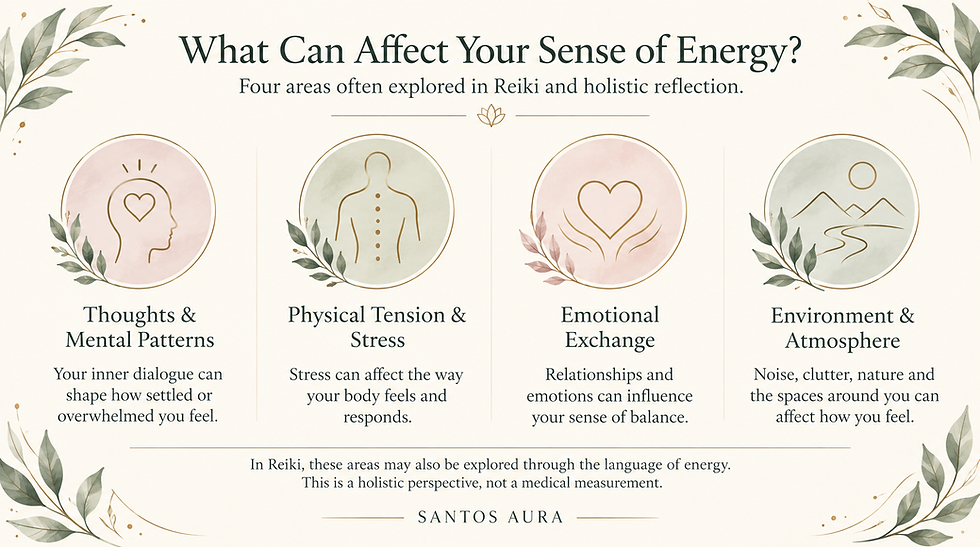
When I speak about energy in everyday life, I often come back to four areas: your thoughts, your physical state, your emotional exchanges with other people, and the environment around you.
Your thoughts matter because the inner conversation you carry all day can leave you settled or exhausted. Your body matters because stress can be felt physically. Your relationships matter because emotions do not stop at the edge of a conversation. And your surroundings matter because noise, clutter, nature, light, privacy and atmosphere can all change the way you feel.
In Reiki language, these areas may also be explored as part of your energetic balance.
What Does ‘Blocked Energy’ Mean in Reiki?
You will often hear Reiki practitioners talk about blocked, stagnant or unbalanced energy. I use those words too, but I use them in the Reiki sense. I am not describing a medical blockage or making a diagnosis.
For me, ‘blocked’ can describe those periods when you feel as though you are holding too much: stress you have not released, emotions that keep returning, a mind that will not settle, or a general feeling of being disconnected from yourself.
A Reiki session gives you time to stop carrying everything for a while. You do not need to explain every feeling. You do not need to find a meaning for every sensation.
Do You Have to Believe in Reiki?
You can believe in energy or not. I am not here to force a belief on you.
So if you are sceptical, you are still welcome. If you already believe strongly in energy, you are welcome too. I would rather you come as you are than try to convince yourself of something before you arrive.
What a Reiki Session Can Feel Like
A Reiki session is usually very quiet. You remain clothed and rest while I work with my hands on or above different areas of the body. There is no pressure to talk, although you can tell me if you are uncomfortable or need anything changed.
People describe very different experiences. Warmth is common. So are tingling, changes in temperature, a feeling of heaviness or lightness, unexpected emotion, drifting thoughts or deep relaxation. Sometimes people fall asleep. Sometimes the mind stays busy. Sometimes very little seems to happen during the session and the person only notices later that they feel calmer.
My Approach to Reiki
My spiritual work is broader than Reiki. I believe in energy, intuition and life after physical death, and these beliefs naturally influence the way I understand connection. At the same time, I want you to have your own experience rather than borrow mine.
I do not look for dramatic reactions. I do not need you to feel heat in my hands, see colours or sense something extraordinary. If you do, we can talk about it. If you do not, that is completely fine.
The purpose is not to prove Reiki. The purpose is to give you time to receive, rest and reconnect with yourself in a way that feels right for you.
I see Reiki as a complementary practice. It can sit alongside the medical or psychological care you already receive rather than replacing it.
Distance Reiki: How Can Reiki Work When We Are Not in the Same Room?
I offer distance Reiki. For me, this is not a lesser version of a hands-on session. It is simply another way of working with Reiki when you and I are not physically in the same place.
This is often the first question people ask: if I am not touching you, how can you receive Reiki?
Within Reiki practice, energy is not understood as something that only works through physical touch. A trained practitioner can work without placing hands on the recipient, holding the person and the intention of the session in awareness while allowing Reiki to flow. The Reiki Council, the UK advisory body for professional Reiki practice, also states that it is possible to receive Reiki at a distance.
What happens during a distance Reiki session with me?
At the agreed time, you make yourself comfortable somewhere you can relax without being disturbed. You can lie down, sit comfortably, close your eyes, listen to soft music or simply rest. There is nothing special you have to do and nothing you have to force yourself to feel.
I prepare for the session in the same way I would for an in-person Reiki treatment:
I ground myself, settle my attention and begin the Reiki practice with you as the recipient.
I work with the whole person rather than trying to force energy towards one symptom or one part of the body.
I may be drawn to spend more time around a particular energetic area, but I allow the session to unfold rather than trying to control it.
Some people tell me they feel warmth, tingling, heaviness, lightness, see colours, sens a physical touch, emotion or a deep sense of calm. Others fall asleep. Some feel very little during the session and notice the difference afterwards.
Do I need to be on a video call?
Distance Reiki does not depend on being physically together. The important part of the session is the Reiki practice itself, not watching me perform it. You can therefore receive while resting in your own space. Where communication is needed, we can connect around the session without turning your Reiki time into a conversation.
For many people, this is one of the reasons distance Reiki feels so accessible. You do not need to travel, prepare a treatment room or be comfortable with touch. You can receive Reiki from your own home, in a place where you already feel safe and settled.
Questions People Often Ask Me
What if I feel nothing during Reiki?
Nothing is wrong. Not everyone experiences physical sensations during a session, and there is no required response.
Can I receive Reiki if I am sceptical?
Yes. I do not ask you to believe in Reiki before experiencing it. Curiosity is enough.
Is Reiki the same as meditation?
No. Meditation usually asks you to take an active role with attention, breath or awareness. During Reiki, you can simply rest while the practitioner carries out the session.
Is Reiki a religion?
No. Reiki itself does not require you to follow a religion. People with religious beliefs, spiritual beliefs or no religious belief can receive Reiki.
Can Reiki be used alongside other forms of care?
Yes. Reiki is generally described as a complementary practice, meaning it can be used alongside conventional care.
Reiki Alongside Conventional Care
You may be surprised to know that Reiki is already offered within some NHS hospital services as a complementary therapy. University College London Hospitals lists Reiki among complementary therapies offered on its wards, and South Tees Hospitals NHS Foundation Trust offers Reiki alongside conventional cancer treatment.
This does not mean the NHS has adopted Reiki as a replacement for medicine. It shows that Reiki can have a place beside conventional care, supporting relaxation and well-being while medical treatment continues. This is also how I see Reiki: it does not have to compete with medicine to have a meaningful place in your care and well-being.
A Final Thought
I could give you a long explanation about energy, chakras and energetic balance. Those are part of Reiki, and we can explore them. But I think your own experience comes first.
You may leave a session feeling deeply relaxed. You may have an emotional response. You may notice subtle sensations, or you may simply enjoy an hour in which nobody needs anything from you.
You do not have to prove Reiki to receive it. And you do not have to abandon your questions in order to be open to an experience.
Source on Current Scientific Evidence
For the current evidence summary referred to in this article, see the National Center for Complementary and Integrative Health: Reiki.

Comments